If you own a country home or small farm in Winchester, it can be tempting to price by gut feel, acreage, or what a neighbor is asking. In this market, that approach can cost you time and leverage. The good news is that with the right pricing strategy, you can position your property more clearly, attract serious buyers, and avoid the drag of repeated price cuts. Let’s dive in.
Winchester pricing takes precision
Winchester and Clark County show a market that is active, but not especially forgiving of overpricing. Redfin reports Winchester’s median closed sale price at $217,370 over the three months ending May 2026, with homes averaging 41 days on market, a 98.1% sale-to-list ratio, and price drops on 34% of listings.
Realtor.com’s June 2026 Clark County report shows a median listing price of $300,000, 286 active listings, and a median 45 days on market, calling the county balanced. Whether you describe the market as somewhat competitive or balanced, the message is the same: buyers are paying attention, and pricing needs to be grounded in real comps.
Sold comps matter more than list prices
When pricing rural property, sold properties tell you far more than active listings. Asking prices show seller expectations, but closed sales show what buyers actually accepted in the current market.
That matters even more in Winchester, where the sale-to-list ratio is 98.1% and more than a third of listings have had price drops. If your home or small farm starts too high, buyers may wait, compare, and move on before you adjust.
Why every acre does not add equal value
One of the biggest mistakes in rural pricing is treating land like it has a flat per-acre value. In reality, one acre may contribute much more or much less depending on how usable it is.
The University of Kentucky’s 2025 county-agent survey says farmland values and rents are influenced by productivity, accessibility, competition, and distance to markets. In the Bluegrass subregion, average values were reported at $8,300 per acre for cropland, $7,600 for hay ground, $6,800 for pasture, and $4,800 for woodland.
Those figures are helpful context, but they are not a shortcut for pricing your tract. A parcel with strong access, functional pasture, and useful layout will be viewed differently than a parcel with steep ground, limited access, or less practical use.
Land quality shapes buyer demand
Soil and site conditions can affect both farm use and overall marketability. University of Kentucky guidance notes that slope, depth, and color help indicate soil characteristics tied to growth and productivity.
Site conditions also matter for homesites, driveways, and everyday use. Flood risk, drainage, soil type, and access can all influence how buyers view the property and what they are willing to pay.
Price the property in layers
A country property should not be priced as one lump sum based only on acreage. Kentucky property valuation guidance shows that residential and farm properties are generally considered through sales comparison, while barns, fencing, and other farm improvements are often valued through a cost approach and then adjusted for depreciation.
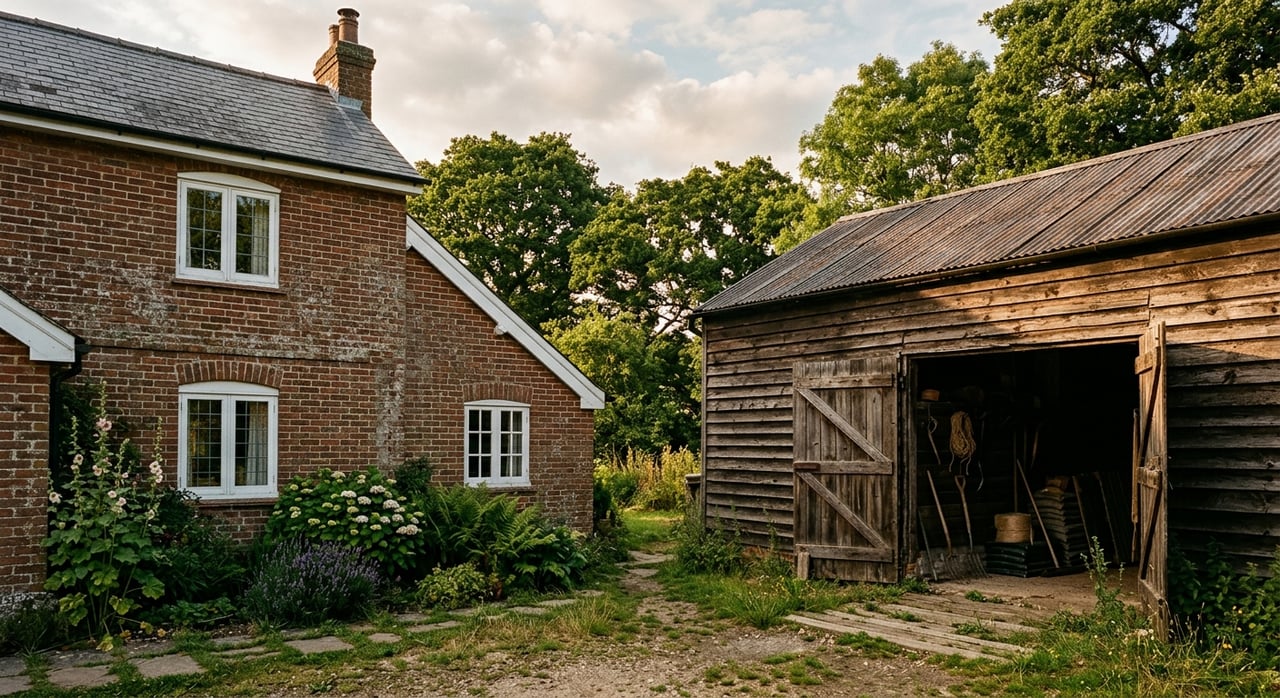
That means your house, outbuildings, fences, driveways, and utility setup each contribute differently. A clean, useful barn in solid condition may help value, but an older structure with deferred maintenance may contribute less than sellers expect.
The home has its own value
The residence should be compared to similar sold homes with similar size, age, condition, and setting. Even on acreage, buyers still look closely at livability, layout, updates, and overall condition.
If the house is the main draw, the property may compete more with other country homes than with purely agricultural land. If the acreage and outbuildings are the main draw, those features still need separate support in the pricing logic.
Barns, shops, and fences add differently
Not all improvements carry the same weight. A functional shop, strong fencing, usable driveway, or well-maintained barn may support value because buyers can use them right away.
At the same time, age, maintenance, and depreciation matter. Buyers tend to pay more for improvements that are clearly functional and easier to maintain, not simply for the presence of more structures.
Utilities and access can move the number
Usability often affects value as much as appearance. Clark County zoning rules require approved water supply and sewage disposal for buildings and mobile homes, and if public mains are accessible, the structure must connect to them.
When systems are clearly in place and compliant, buyers often feel more confident. Good access, practical utility setup, and fewer question marks can make a rural property easier to market and easier to justify at a strong price.
Tax assessment is not market value
Another common pricing trap is anchoring to the tax bill or assessed value. In Kentucky, farmland may be assessed at agricultural value instead of market value.
The Kentucky Department of Revenue notes that the difference can be substantial where development pressure is stronger. For sellers in and around Winchester, that means an assessment may have little relationship to what buyers would pay in the open market.
Zoning and buildability can change perception
For country homes and small farms, local rules can affect value in very practical ways. Clark County treats agricultural buildings and accessory buildings differently in some cases, and certain setbacks, height limits, floodplain rules, and utility requirements can affect what a buyer believes they can do with a property.
That does not mean every tract has future split or homesite value. It means those possibilities should be confirmed before they are used in pricing or marketing.
Family farm homesite rules matter
Clark County has a specific family farm homesite rule that can affect how a tract is positioned. Under county code, qualifying farms generally need to be at least 7 acres and less than 25 acres with five years of ownership, or at least 25 acres with five years of ownership.
The rule also includes requirements such as a minimum one-acre homesite, access through a 20-foot easement, and no new entrances on county roads. If your property may have this kind of potential, it needs to be verified carefully before that possibility is used as a selling point.
How to position a Winchester rural property
The best marketing angle usually follows the property’s strongest real-world use. Some properties show best as a country home with acreage, while others fit more naturally as a hobby farm, horse property, or small farm.
That decision should come from the land, improvements, access, and utility setup, not just from what sounds appealing. Clear positioning helps attract the right buyers and supports a pricing story that makes sense.
Focus on the features buyers value most
For many rural buyers, the biggest questions are practical. They want to know how usable the pasture is, whether access is straightforward, what the water and sewage setup looks like, and whether the property has buildable or expandable potential under local rules.
When those answers are clear, pricing becomes easier to defend. When they are vague, buyers often price in more caution.
A smart pricing approach for sellers
If you are preparing to sell a country home or small farm in Winchester, a strong pricing strategy usually includes a few key steps:
- Start with recent sold comps, not just active competition
- Separate land value from home value and improvement value
- Evaluate usability, access, drainage, and site conditions
- Review barns, fencing, shops, and driveways based on condition and function
- Confirm zoning, utility setup, and any homesite or split-related potential before marketing it
- Avoid relying on tax assessment as a pricing shortcut
This kind of pricing takes more work than a simple price-per-acre formula, but it usually leads to a better market response. It helps buyers understand what they are paying for and helps you enter the market with more confidence.
Winchester rural properties are rarely one-size-fits-all. If you want a pricing strategy that reflects the land, the improvements, and the realities of Clark County, working with a local advisor who understands how these properties are bought and sold can make a real difference. When you’re ready for tailored guidance, connect with Janna Smith.
FAQs
How should you price a country home in Winchester, KY?
- Start with recent sold comps, then adjust for acreage usability, home condition, outbuildings, access, utilities, and local zoning factors.
Why doesn’t every acre add the same value on a Clark County property?
- Acre value can change based on productivity, accessibility, pasture or woodland use, drainage, flood risk, and overall practicality.
Do barns and fences add value to small farms in Winchester?
- Yes, but their contribution depends on condition, function, age, and depreciation rather than simple replacement cost alone.
Should you use tax assessment to price a small farm in Kentucky?
- No. Tax assessment may reflect agricultural value rather than open-market value, so it should not be used as the main pricing guide.
Can future homesite potential affect small farm pricing in Clark County?
- Yes, but only when the tract meets local requirements and that potential is confirmed before marketing.
What features matter most to buyers of Winchester acreage?
- Buyers often focus on usable ground, access, water and sewage setup, improvement condition, and whether the property is straightforward to use and improve.